Why Analog Photography Still Matters for Architecture
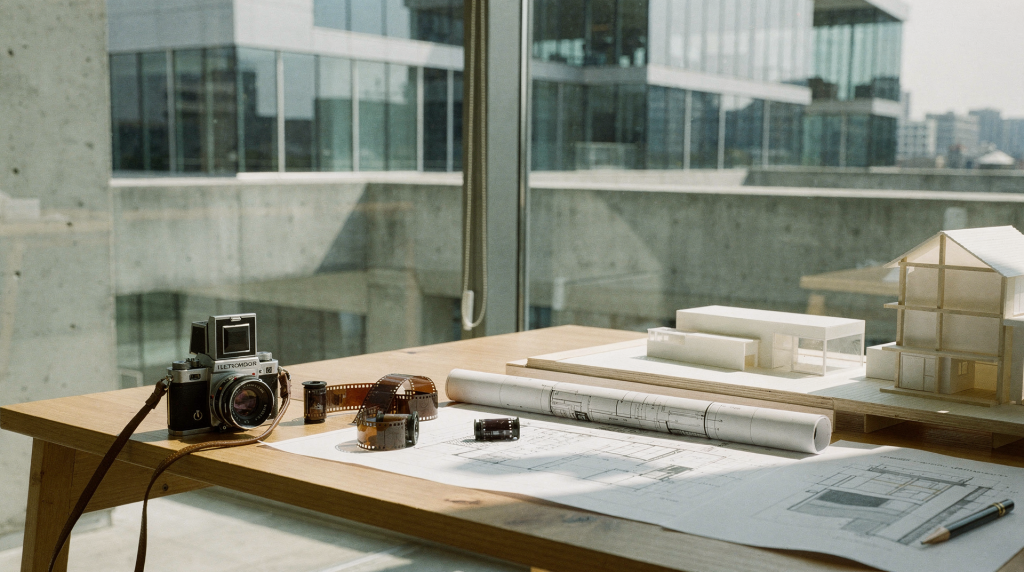
There’s a moment during every architectural film shoot when the light settles into a room and the handheld meter gives you a reading that feels right — not just technically, but emotionally. That’s the difference. Digital can document a space with surgical precision, but film translates it. It gives you grain where plaster has grain, tonal softness where shadow meets window light, and a physical negative that exists as an object, not just a file. Analog still matters in architecture because it refuses to flatten a building into mere geometry. It records light, material, and time in a way that feels honest — and increasingly rare.
Why film still has a place in architectural photography
Architecture, at its core, is about surfaces catching light. Brick, render, glass, timber — each material responds differently as the sun moves across it, and film responds to those shifts with a rhythm digital rarely matches. Grain doesn’t sit on top of the image like noise reduction’s afterthought; it’s woven into the emulsion, giving texture to walls and ceilings that might otherwise read as sterile. Tonal transitions, especially in the midtones and highlights, roll off gradually rather than clipping abruptly. That’s not a flaw to correct — it’s the medium’s vocabulary.
When I’m working inside an old house with uneven floorboards and decades of paint on the trim, the slower pace of film becomes an asset. Twelve frames on a roll of 120 means every composition gets interrogated before the shutter fires. You walk the room, watch where the light pools, notice how a doorframe leans half a degree off plumb. That attention carries into the final image. You’re not overprocessing later to rescue a shot you barely considered in the moment — you built the photograph on site, with intention.
For heritage properties and design-led spaces where mood matters as much as documentation, film creates a visual language that feels believable. It doesn’t just show what a room looks like; it suggests what it feels like to stand in it, to hear the floor creak, to sense the weight of the air. That’s not nostalgia talking — it’s the result of a medium that records light continuously rather than sampling it in discrete steps.
What analog captures that digital often smooths out
A building is rarely the clean, vector-perfect version we see in renderings. It has hairline cracks in the plaster, worn spots on the stair treads, matte paint that absorbs light differently than the gloss on the window frame. Digital sensors, especially with aggressive noise reduction and sharpening algorithms, tend to homogenize those subtle differences. Film preserves them organically — not because it’s technically superior in resolution charts, but because its imperfections align with the imperfections of built materials.
This matters enormously when photographing old homes, historic interiors, or any space where age is part of the story. The highlight roll-off alone is worth the price of a roll: a sunlit window doesn’t blow out to a harsh white edge; it feathers into the surrounding wall, holding detail in the transition that digital would lose unless you bracket and composite. And bracketing on film, when you do it, feels like a deliberate choice rather than a safety net.
Key qualities that make film relevant:
- Grain with purpose: Film grain isn’t a defect to remove — it’s a surface character that complements brick, stone, wood, and textile textures. In medium format, the grain structure can actually enhance the perception of sharpness without looking noisy.
- Natural tonal transitions: Film handles subtle differences between light and shadow with a gentleness that feels less clinical. Midtones carry weight, and highlights breathe rather than clip.
- Material honesty: Film emphasizes the physicality of a room — the way plaster absorbs light, how dust motes hang in a sunbeam — without making the space feel overly corrected or sterile.
- A slower mindset: The cost per frame and the finite number of exposures on a roll encourage precision. When every angle and reflection matters, that discipline shows in the work.
When film works especially well in architecture
Film isn’t the right tool for every job. If a client needs fifty clean, consistent images for a real estate listing by tomorrow afternoon, I’ll point them toward a digital workflow without hesitation. But when the brief asks for interpretation — when the space has a story that needs telling rather than just cataloguing — film becomes the stronger choice.
Best use cases
- Heritage homes and historic properties where patina is part of the value
- Editorial interiors for magazines and design publications that prize atmosphere
- Design-led hospitality spaces — boutique hotels, restaurants, bars — where the lighting design is intentional and worth honoring
- Personal architectural portfolios for architects and designers who want their work to feel tactile
- Documentary-style property storytelling, especially for long-form projects or books
- Projects where atmosphere is explicitly part of the brief, not an afterthought
Film is particularly effective in spaces that rely on natural light. The medium rewards careful exposure and attention to how daylight enters the room — the angle of the sun through a sash window, the way it rakes across a limewashed wall, the soft bounce from a courtyard. Exterior work also benefits at transitional light: dawn and dusk, when the building’s form needs to sit naturally against the sky and surrounding environment. Long exposures on film during twilight can render a façade with a depth that feels painterly rather than documentary.
Choosing the right film stock for architectural work
Stock choice isn’t just about speed — it’s about how the emulsion draws the space. Faster films bring flexibility and a certain grittiness that can work beautifully for raw, industrial interiors. Slower films deliver cleaner detail and finer grain, which suits projects where the architecture itself is the hero. The table below reflects what I’ve settled on after years of testing different emulsions in different light.
| Film type | Best for | Visual result | Practical note |
|---|---|---|---|
| ISO 100 color film | Bright exteriors, controlled interiors | Fine grain, crisp detail | Best when light is abundant; rewards a tripod indoors |
| ISO 160 color film | Soft-lit interiors | Gentle color, smoother tonal response | Excellent for rooms with large windows and indirect light |
| ISO 400 color film | Mixed-light interiors | Flexible exposure latitude | Useful when light changes across a space or you’re moving between rooms quickly |
| Medium format film | Architectural portfolios, large prints | Higher detail and finer grain | Strong choice for interiors and façades; the larger negative holds more tonal information |
For many architectural shooters, a practical starting point is ISO 100 for daylight exteriors and ISO 400 for interiors with mixed light. If the brief emphasizes detail and print quality, medium format is almost always the better analog format — the larger negative area gives more room for tonal nuance and less apparent grain, which matters when you’re printing at scale or delivering files for high-end editorial use. I’ve shot entire projects on Portra 400 in 120 and never felt limited; the latitude handles window light and shadow corners with equal grace.
How to shoot interiors on film without losing control
Interior architectural photography on film is about method, not mystery. The biggest challenge isn’t the camera or the stock — it’s the contrast between windows and the room itself. A sunlit window can easily be four or five stops brighter than the interior wall beside it. Digital shooters often bracket and blend; on film, you learn to meter intelligently and accept that some highlight loss may be part of the image’s character.
A simple workflow
- Use a tripod
Long exposures are common indoors — a half-second at f/11 isn’t unusual in a north-facing room. Stability matters more than speed, and a solid tripod also forces you to compose deliberately. - Level the camera
Keep vertical lines straight so walls and door frames don’t lean unnaturally. A hot-shoe bubble level is cheap insurance against converging verticals that can’t be fully corrected later. - Meter for the room, not just the window
Window highlights can blow out quickly. Expose with the interior tones in mind — I often meter the midtones of a wall or floor and let the windows go a stop or two over. The film’s highlight latitude usually holds more detail than you’d expect. - Bracket when necessary
Film latitude helps, but high-contrast interiors still benefit from testing more than one exposure. A half-stop bracket in either direction can save a frame when the light is tricky. - Work with available light first
Natural light usually gives a more believable result than forcing the room with artificial sources. If you must supplement, bounce it off a ceiling or wall rather than pointing it directly at the scene.
Common mistakes to avoid
- Exposing only for the brightest window and losing the room to shadow
- Forgetting that film needs more deliberate metering than digital — matrix metering habits don’t translate
- Using a stock that is too slow for dim rooms and ending up with shutter speeds that invite motion blur
- Relying on framing corrections in post instead of getting verticals right in-camera
- Overlooking reflections in mirrors, glass, and polished surfaces — these can ruin an otherwise strong composition
Analog vs digital for property documentation
Digital is faster, more flexible, and easier for high-volume documentation. Film is slower, more deliberate, and often more expressive. Neither is inherently superior — the right choice depends entirely on the purpose of the shoot and the story the images need to tell.
| Factor | Analog film | Digital |
|---|---|---|
| Feedback | Delayed until development — which can be a creative advantage | Immediate review on site — useful for client collaboration |
| Shooting pace | Slow and selective; every frame counts | Fast and iterative; volume is cheap |
| Grain/detail | Physical grain and texture that integrates with surfaces | Clean, highly controlled rendering with adjustable noise profiles |
| Post-production | Limited, more final in-camera; the negative is the reference | Extensive correction and compositing possible; the raw file is the starting point |
| Best use | Story, atmosphere, heritage, editorial narrative | Efficiency, precision, volume, commercial documentation |
For property documentation, digital usually wins when the job needs speed, consistency, and a large image set delivered quickly. Film wins when the assignment asks for interpretation, narrative, and a more tactile visual identity — the kind of images that feel like they belong in a monograph rather than a listing portal. I’ve worked both ways, and the deciding factor is almost always the question: is this space being sold, or is it being remembered?
Why analog matters culturally, not just aesthetically
Architecture is a record of how people live, build, and remember. A building carries the marks of its occupants — scuffed thresholds, faded wallpaper, the particular way light falls through a window that’s been there for a century. Film fits that idea because it carries a sense of duration. A negative is a physical object, a strip of acetate that holds a latent image formed by photons bouncing off real surfaces. That physicality matters when documenting spaces with historical value or emotional weight.
In practice, analog photography can make architecture feel less like a product and more like a lived environment. It doesn’t erase age; it reveals it with more empathy. For old houses, landmark buildings, and interiors shaped by use over time, that’s not a stylistic quirk — it’s a form of respect. The grain in the emulsion echoes the grain in the wood. The slight softness at the edges of the frame mirrors the way memory itself works. These aren’t defects; they’re the reasons film continues to matter in a field that could easily default to digital perfection.
Practical checklist for an architectural film shoot
- Confirm whether the brief is documentary, editorial, or atmospheric — this determines stock, pacing, and how you handle light
- Choose film based on lighting conditions, not habit — scout the space beforehand if possible
- Bring a tripod and a leveling tool; a cable release is worth its weight for long exposures
- Check reflective surfaces before every frame — mirrors, glass, polished stone, even glossy paint can catch unwanted highlights
- Meter carefully and bracket when contrast is severe; a half-stop can make the difference between a usable negative and a lost frame
- Plan around natural light rather than fighting it — note where the sun will be at different times of day
- Keep notes on stock, exposure, and scene conditions for future reference — this pays off when you develop and want to understand what worked
Typical situations and what to use
| Situation | Recommended approach | Why |
|---|---|---|
| Bright exterior façade | ISO 100 film, tripod optional | Clean detail and fine grain; plenty of light for handheld work if needed |
| Mixed-light living room | ISO 400 film, tripod required | More flexibility in exposure; handles the range between window light and shadow corners |
| Historic interior with texture | Medium format if possible | Better tonal depth and print quality; the larger negative does justice to surface detail |
| Twilight exterior | Careful long exposure | Balances building and sky naturally; film’s reciprocity characteristics can add a subtle warmth |
| Editorial heritage feature | Slower, deliberate shooting | Supports narrative and mood; gives the space room to breathe across a smaller frame count |
FAQ
Is analog photography still practical for architecture?
Absolutely — especially for editorial, heritage, and design-focused work where atmosphere matters as much as accuracy. The logistics of film (buying stock, developing, scanning) are more involved than a digital workflow, but for the right project, the results justify the effort. I’ve had architects tell me that film images of their work feel more like the space they designed than any digital file they’ve received.
What film is best for interiors?
ISO 400 color film is often the most flexible starting point — it handles mixed light well and gives you workable shutter speeds even in dim rooms. ISO 100 or 160 works beautifully in brighter spaces with controlled light, especially when you want finer grain and more saturated color. My personal default for interior work is Portra 400 in 120 format; it’s forgiving, scans beautifully, and holds shadow detail that cheaper stocks lose.
Why do many photographers prefer medium format for architecture?
Medium format usually delivers finer grain, more detail, and a more polished look for large prints and interiors. The larger negative area — roughly 2.7 times the size of 35mm for 6×7 — means tonal transitions are smoother and the image holds up better under enlargement. For architectural portfolios and editorial work, that extra resolution and tonal depth is worth the heavier camera and slower pace.
Is film better than digital for property documentation?
Not always. Digital is usually better for speed and volume — think real estate listings, commercial portfolios, or any job requiring dozens of consistent images on a tight deadline. Film is better for mood, texture, and storytelling — the kind of documentation that aims to preserve the feeling of a place rather than just its dimensions. The two aren’t competitors; they’re different tools for different intentions.
What is the biggest challenge when shooting interiors on film?
High contrast between windows and interior surfaces. A bright window can easily be four or five stops hotter than the room, and film doesn’t give you an instant preview to check. Careful metering — exposing for the interior midtones and letting the windows go — combined with a tripod and occasional bracketing, keeps the situation under control. It’s a skill that develops with practice, and it’s one of the reasons shooting film makes you a more attentive photographer overall.
Conclusion
Analog photography still matters for architecture because it changes how a space is seen, recorded, and remembered. It’s not about rejecting digital — it’s about recognizing that some projects call for a medium that brings texture, patience, and emotional depth to built environments. Film makes plaster feel like plaster, light feel like light, and time feel like something that actually passed through the room. For interiors, heritage properties, and any project where the story of the space is as important as its structure, film remains a serious and relevant choice — not despite its limitations, but because of what those limitations demand from the photographer.