My Favorite 35mm Film Cameras for Personal Projects
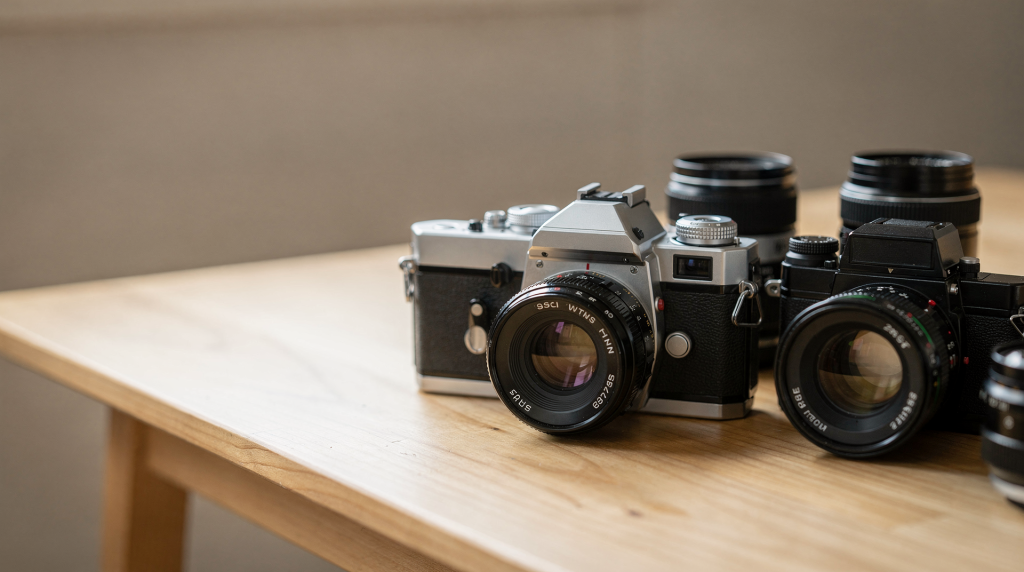
My Favorite 35mm Film Cameras for Personal Projects
There is a particular rhythm to shooting personal work on 35mm — a kind of quiet momentum that larger formats rarely allow. The camera slips into a bag without a second thought, the advance lever becomes an extension of your thumb, and before you know it you have burned through a roll simply because the light kept shifting and you wanted to see how the emulsion would handle it. I have dragged medium format kits through enough doorways to know that sometimes the best camera is the one you do not have to negotiate with. For the projects that matter most — the ones without a brief, without a deadline, without anyone waiting for the contact sheet — 35mm remains the format I reach for first.
The cameras on this list are not museum pieces. They are tools I have loaded in the passenger seat, dropped into coat pockets, and trusted to finish a roll when the temperature dropped and my fingers went numb. Each one has taught me something about how film translates a space, how grain settles into shadow, how a lens draws the edge of a windowsill or the worn tread of a staircase. That is what personal work is really about: not the perfect frame, but the honest one.
Why 35mm still works so well for personal work
Personal projects run on momentum. The moment you stop to overthink, the light moves, the scene dissolves, or you talk yourself out of the shot entirely. What you need is a camera that removes friction — something that lets you stay inside the seeing rather than stepping outside to manage the gear. That is where 35mm excels, and why I keep returning to it even when a larger negative is technically within reach.
Compared with medium format or large format, 35mm gives you a set of practical advantages that directly serve the way personal work unfolds:
- lower cost per frame, which means you shoot more and edit later instead of rationing exposures
- smaller bodies and lighter lenses — the difference between a camera that lives on your shoulder and one that lives on a shelf
- faster handling in real-world situations, especially when natural light is changing inside a room with three different window exposures
- enough image quality for prints, web galleries, and editorial storytelling — grain becomes texture, not a limitation
- a look that feels immediate, familiar, and slightly imperfect in a way that digital still struggles to replicate
For me, that balance matters more than technical perfection. Personal work rewards consistency and presence, not obsession over MTF charts. When I am documenting a building — tracing how morning light moves across plaster walls, how the grain of old floorboards catches the sidelight — I want the camera to stay out of the way. 35mm does that. The imperfections are part of the translation: a little softness at the edges, a grain structure that feels organic rather than sterile, a sense that the image remembers the moment it was made.
What I look for in a 35mm camera
Before naming specific bodies, it helps to define the traits that actually matter when you are standing in a room with a roll of Tri-X loaded and the afternoon light doing something unexpected. Over years of shooting personal projects — many of them rooted in architecture and interior spaces — I have narrowed it down to five qualities that separate a camera you use from one you admire.
1. Reliability
A personal-project camera should be ready when you are. If a body is beautiful but unpredictable — if the shutter hesitates, if the meter drifts, if the film advance feels gritty — it tends to stay on the shelf. I have lost too many frames to cameras that worked perfectly on the kitchen table and then seized up on location. For the kind of work I do, where I might be documenting a 19th-century townhouse with no second chance to revisit the light, reliability is non-negotiable.
2. Simple controls
The fewer barriers between seeing a scene and making a frame, the better. Fast loading, readable meters, and intuitive controls keep you moving. When I am working inside a building, moving from a sunlit parlor to a dim hallway and back again, I need the exposure adjustments to happen almost without thinking. A camera that buries essential functions in menus or requires too much conscious effort breaks the flow. Personal work thrives on that flow.
3. Lens quality
A good lens can carry an entire project. Sharpness matters, but so does character: contrast, flare behavior, and how the lens handles light at different apertures. When I photograph architecture, I am paying attention to how the glass renders the edge of a moulding, the texture of aged brick, the way light falls off toward the corners of the frame. Some lenses draw with clinical precision; others have a gentleness that suits older buildings. Both have their place, but you need to know what you are working with.
4. Size and handling
If a camera is too heavy or too conspicuous, you stop bringing it places. For personal work, portability often wins. I have learned this the hard way — leaving a beautiful but bulky kit at home and missing the shot entirely. A camera that disappears into your routine, that you can carry through a city for hours without fatigue, gets used more often. And more use means more work, which is the whole point.
5. Metering you can trust
A dependable meter saves film and makes shooting in changing light much easier, especially outdoors or in interiors with mixed illumination. Old buildings are full of tricky light: bright windows next to deep shadow, incandescent warmth spilling into daylight-cool corners. A meter that reads consistently lets you concentrate on composition instead of second-guessing exposure. When I am working quickly, I need to trust what the needle or LED is telling me.
My favorite 35mm film cameras for personal projects
Canon AE-1 Program
This is one of the most practical all-around 35mm cameras for personal work, and it was the body I recommended most often when friends asked where to start. It has a straightforward control layout, easy-to-find lenses, and enough automation to keep you shooting without feeling disconnected from the process. The FD lens mount opens up a huge range of affordable glass, and the metering is reliable enough that you can concentrate on the space in front of you rather than the numbers.
I have used the AE-1 Program to document everything from quiet residential interiors to street scenes in changing light, and it rarely lets me down. The shutter sound is satisfying without being loud, and the body sits comfortably in hand for hours. For architectural details — a staircase banister, a row of windows, the way light pools on a wooden floor — the standard 50mm f/1.8 renders with a warmth that suits older buildings.
Why it works:
- accessible and intuitive — you can hand it to someone who has never shot film and they will find the rhythm quickly
- good lens ecosystem with plenty of affordable FD options
- solid for learning manual exposure while having program mode as a safety net
- light enough for everyday carry without feeling fragile
Best for:
- beginners moving beyond point-and-shoots who want to understand exposure
- personal documentary work where speed and reliability matter
- travel and street photography — it is unobtrusive and quick to operate
Watch out for:
- old foam seals that turn to sticky dust — budget for a replacement kit
- battery dependence — carry a spare, because when the battery dies the camera stops
- cameras that were heavily used and poorly stored — check the mirror dampener and shutter curtains
Nikon FE2
If I had to choose one camera for personal projects that need a little more precision — especially when I am working inside buildings where exposure accuracy makes or breaks the frame — the FE2 would be high on the list. It feels controlled, dependable, and responsive without becoming fussy. The match-needle metering is clear and fast to read, and the stepless shutter in aperture-priority mode handles subtle light shifts beautifully.
I have used the FE2 extensively for architectural details and interiors. The Nikon glass renders with a clarity that holds fine textures — the grain of plaster, the weave of a curtain, the patina on brass hardware — without feeling clinical. The body is compact enough to carry all day, and the mechanical backup speeds (1/250th and B) mean you are never completely stranded without batteries.
Why it works:
- excellent build quality — these were made to last and it shows in the winding action and shutter feel
- reliable shutter and metering that stays consistent across rolls
- strong lens support through the Nikon F mount, with decades of glass to choose from
- great balance between manual control and aperture-priority convenience
Best for:
- photographers who want one camera to grow with over years
- architectural details, interiors, and travel — the metering handles mixed light well
- projects where accurate exposure matters and you do not want to bracket every frame
Watch out for:
- condition varies widely — look for bodies that have been used regularly rather than stored for decades
- older electronics can fail if the body has not been serviced; a CLA is worth the investment
Olympus OM-1
The OM-1 is small, elegant, and genuinely pleasant to carry. That matters more than people admit. A camera that disappears into your routine — that you can slip into a coat pocket or carry on a wrist strap for hours — gets used more often. And more use means more frames, more experiments, more personal work actually getting made.
I reach for the OM-1 when I want to slow down and work deliberately. The fully manual operation keeps me engaged with every decision: aperture, shutter speed, focus. There is no automation to lean on, and for certain projects — especially quiet architectural essays where I am studying how light moves through a space — that tactile rhythm becomes part of the seeing. The Zuiko lenses are excellent, with a rendering that feels natural and unforced. The 28mm f/2.8 and 50mm f/1.4 are particularly strong for interior work.
Why it works:
- compact and lightweight — one of the smallest SLR systems ever made
- fully manual, which keeps you engaged with every exposure decision
- excellent for quiet, deliberate shooting where you want to study the light
- ideal if you like a minimal setup — body, one lens, a roll of film
Best for:
- personal essays that benefit from a slower, more contemplative pace
- candid city work where a small camera draws less attention
- photographers who prefer a tactile, mechanical shooting rhythm
Watch out for:
- meter batteries may require adaptation — the original mercury cells are discontinued, but workarounds exist
- some copies need service after long storage — check the prism for desilvering and the shutter for capping
Pentax K1000
The K1000 became famous for a reason: it is simple, durable, and stripped down to the essentials. For personal projects, that simplicity can be a profound strength. There is nothing to distract you — no program modes, no exposure compensation dials, just a match-needle meter and the three variables that have always defined photography: aperture, shutter speed, and focus.
I have a soft spot for the K1000 because it teaches you to feel the light. When you are documenting a building, moving from room to room, you start to anticipate exposure before the meter confirms it. That intuition carries over to every other camera you will ever use. The Pentax K-mount lenses are plentiful and affordable, and the mechanical shutter means the camera works without batteries — the meter is the only thing that needs power.
Why it works:
- extremely easy to learn — the controls are obvious and the feedback is immediate
- durable mechanical design that tolerates neglect better than most
- no unnecessary distractions — just the essentials, done well
- good starter camera if you want full manual control and a foundation in exposure
Best for:
- learning exposure through practice rather than theory
- student work and long-term projects where the process matters as much as the result
- photographers who want a camera that will survive rough handling
Watch out for:
- basic handling compared with more refined bodies — the viewfinder is decent but not exceptional
- popularity means condition varies a lot — look for one that has been used and maintained
Contax G1
If your personal work leans toward sharper, more deliberate frame-making — the kind where the edge of a cornice or the geometry of a window grid matters — the Contax G1 is worth serious attention. It offers excellent Zeiss lenses in a compact rangefinder-style system that travels beautifully. The optics are the star here: the 45mm f/2 Planar and the 28mm f/2.8 Biogon render with a clarity and contrast that make architectural lines sing.
I have used the G1 for travel projects where I wanted to document buildings with precision but without the bulk of an SLR kit. The autofocus, while not as refined as modern systems, is fast enough for considered work. The real draw is the glass — there is a three-dimensionality to the Zeiss rendering that makes spaces feel present on film in a way that is hard to describe but immediately recognizable. For personal projects where lens character drives the narrative, the G1 delivers.
Why it works:
- outstanding optics — the Zeiss lenses are among the best available for 35mm film
- compact travel-friendly design that fits into a small bag or large pocket
- fast autofocus for a film camera, especially with the 45mm
- strong image quality for the format — fine detail holds up well in scans and prints
Best for:
- travel projects where weight and space are limited
- architecture — the lenses handle straight lines and fine detail beautifully
- personal projects where lens rendering matters more than shooting speed
Watch out for:
- autofocus quirks — the system can hunt in low light or with certain lenses
- compatibility limitations — some G2 lenses do not work fully on the G1
- more expensive than many classic SLRs, and the lenses add to the investment
Leica M6
The M6 is not the most affordable choice, but it remains one of the best cameras for personal projects if you value quiet operation, compact size, and a clear shooting experience. There is a reason so many documentary and street photographers have gravitated toward the M system: the camera disappears in use. The viewfinder is bright and uncluttered, the shutter is quiet enough to go unnoticed in a quiet room, and the rangefinder focusing encourages a kind of compositional precision that becomes second nature.
For architectural work, the M6 rewards patience. You slow down. You consider the edges of the frame more carefully. The M-mount lens ecosystem is vast, and the glass — whether vintage or modern — renders with a character that feels inseparable from the history of the medium. When I am working on a long-form personal essay about a place, the M6 is often the camera I reach for because it makes the act of photographing feel intentional without being precious.
Why it works:
- discreet and beautifully balanced — the weight and size feel just right in hand
- excellent manual shooting experience with a rangefinder that encourages careful composition
- strong lens ecosystem spanning decades of exceptional glass
- encourages a deliberate, thoughtful approach to each frame
Best for:
- long-form personal essays where consistency of vision matters
- street work and quiet interior documentation
- projects where you want a camera that fades into the background of the experience
Watch out for:
- cost — bodies and lenses represent a significant investment
- service history matters a lot — budget for a CLA if the camera has not been used recently
- lenses can become the bigger investment than the body over time
Nikon FM2
This is one of the most dependable mechanical 35mm cameras ever made. If a personal project needs a camera that feels nearly indestructible — something you can take into harsh weather, rough terrain, or simply the unpredictability of daily life — the FM2 belongs on the shortlist. The fully mechanical shutter operates from 1 second to 1/4000th without batteries, and the build quality inspires confidence every time you advance the film.
I have used the FM2 for outdoor architectural projects where conditions were less than ideal: cold mornings, dusty attics, damp basements. It never hesitated. The Nikon glass available for the F mount is excellent, and the body is easy to service compared with many electronic alternatives. The meter is center-weighted and reliable, though you give up the aperture-priority convenience of the FE2. For some photographers, that trade-off is a feature, not a bug.
Why it works:
- mechanical reliability — the shutter fires consistently in conditions that would strand an electronic body
- fast shutter speeds up to 1/4000th, which is rare for a mechanical camera
- very good lens choices through the Nikon F mount
- easy to service compared with some electronic bodies — many technicians know the FM2 inside and out
Best for:
- outdoor work in unpredictable weather and rough environments
- travel where you need a camera that can take knocks and keep working
- shooters who want confidence in harsh conditions without battery anxiety
Watch out for:
- heavier than some alternatives — the all-metal construction adds weight
- meter-only workflow may not suit everyone — there is no aperture-priority mode
Quick comparison table
| Camera | Strengths | Best for | Main trade-off |
|---|---|---|---|
| Canon AE-1 Program | Easy to use, common lenses | General personal projects | More electronic dependence |
| Nikon FE2 | Accurate, versatile, refined | Travel, interiors, documentary | Condition matters |
| Olympus OM-1 | Small, quiet, tactile | Minimal everyday shooting | Older meter setups |
| Pentax K1000 | Simple, durable, affordable | Learning and long-term use | Basic handling |
| Contax G1 | Sharp lenses, compact system | Travel, architecture | Autofocus quirks |
| Leica M6 | Discreet, elegant, rewarding | Long-form personal work | High cost |
| Nikon FM2 | Mechanical, robust, dependable | Hard-use shooting | Heavier body |
When I look at this table, what strikes me is how different the shooting experience is across these bodies despite them all using the same film format. The OM-1 and the FM2 could not feel more different in hand, yet both have produced remarkable personal work in the right hands. The choice really does come down to how you shoot and what you shoot — a camera that excels for street photography might frustrate you when you are trying to document a quiet interior with careful attention to vertical lines.
Best camera by shooting style
If you want the easiest entry point
Choose the Pentax K1000 or Canon AE-1 Program. Both are straightforward and have huge user communities, which means you will find answers to almost any question. The K1000 forces you to learn exposure from the ground up; the AE-1 Program gives you a safety net while you build confidence. For someone just starting to explore how film renders architectural spaces, either body will serve you well.
If you want the best balance of quality and usability
Choose the Nikon FE2 or Nikon FM2. They are especially strong if you want one body to do almost everything — from careful interior studies to fast-moving street scenes. The FE2 adds aperture-priority convenience for when light is changing quickly; the FM2 gives you full mechanical independence. Both give you access to decades of excellent Nikkor glass.
If portability matters most
Choose the Olympus OM-1. It encourages you to bring the camera everywhere, and that simple fact — having a camera with you — leads to more work than any spec sheet advantage ever could. The small size also makes it less conspicuous when you are photographing in public spaces or documenting buildings without drawing attention.
If lens rendering matters most
Choose the Contax G1 or Leica M6 system if the budget allows. The Zeiss and Leica glass available for these mounts renders with a character that is difficult to replicate. For architectural work, where the way a lens draws fine detail and handles contrast directly shapes how a building reads on film, the investment in optics pays off in every frame.
What to check before buying
A used film camera can be a great purchase or a frustrating one. I have bought bodies that looked perfect in listing photos and arrived with sticky shutters, dead meters, and light seals that crumbled at the first touch. Over time, I have developed a checklist that has saved me from the worst surprises. Before you commit, inspect the following:
- shutter speeds fire consistently — test every speed, especially the slow ones where problems show up first
- film advance is smooth — any grinding, hesitation, or uneven resistance is a red flag
- light seals are intact or replaceable — degraded seals are common and fixable, but factor the cost into the price
- viewfinder is clean enough to compose accurately — some dust is normal, but haze or fungus affects usability
- meter responds properly — point the camera at a light source and then a dark area; the reading should change smoothly
- battery compartment is corrosion-free — even minor corrosion can spread and damage contacts
- lens glass has no major haze, fungus, or separation — shine a flashlight through the lens and look carefully
- focus and aperture rings move smoothly — stiff or gritty rings suggest dried lubricants or impact damage
- the seller can describe recent use or service history — a camera that has been sitting unused for years may need more work than one that was regularly exercised
If possible, ask for:
- sample photos — even phone snapshots of prints or scans can reveal light leaks or shutter issues
- a short video of the shutter firing at different speeds — listen for consistent timing and any odd sounds
- close-up photos of the battery chamber and prism/viewfinder — these areas often show the first signs of neglect
Common mistakes when choosing a 35mm camera
Buying for reputation instead of use
A famous camera is not automatically the right camera. I have watched photographers buy legendary bodies because they appeared in lists like this one, only to find that the handling did not suit them at all. If a camera feels awkward in hand — if the controls are in the wrong places, if the viewfinder does not work with your glasses, if the weight fatigues you after an hour — you will shoot less. Personal projects need a camera that fits you, not a camera that impresses other people.
Ignoring maintenance costs
A cheap body may need seals, servicing, or a lens repair that costs more than expected. I have seen $50 cameras turn into $300 projects after a CLA and light seal replacement. That is not necessarily a bad outcome — a serviced camera can run for another decade — but you should budget for it upfront rather than being surprised later.
Overvaluing features you won’t use
Auto modes, multiple metering patterns, or advanced exposure features can sound useful, but many personal projects benefit more from simplicity. When I am photographing architecture, I rarely want the camera making decisions for me — I want to place the exposure exactly where I intend, based on how I want the shadows and highlights to render on film. Extra features add complexity without always adding value.
Forgetting about lens availability
A body is only half the system. Check how expensive and available the lenses are before you buy. Some mounts have abundant, affordable glass (Nikon F, Pentax K, Canon FD). Others have excellent but costly options (Leica M, Contax G). If you cannot afford the lenses you want, the body will sit underused regardless of how good it is.
My practical recommendation
If you want one dependable 35mm camera for personal projects, I would start with one of these three:
- Nikon FE2 for flexibility and long-term use — it handles almost any situation well and gives you room to grow
- Olympus OM-1 for portability and quiet shooting — it encourages you to carry a camera everywhere, which is half the battle
- Canon AE-1 Program for an easy, affordable, well-supported path — it is forgiving enough for beginners and capable enough to keep experienced shooters engaged
If you already know you want a more tactile, stripped-back experience, the Pentax K1000 is still a strong choice. There is something valuable about a camera that refuses to do anything for you — it teaches you to read light in a way that more automated bodies never will. If you want the best lens character and do not mind paying more, look at the Leica M6 or Contax G1. The glass available for these systems renders spaces with a presence that is hard to describe but easy to see.
A simple buying checklist
- decide whether you want automatic exposure, manual control, or both — be honest about how you actually shoot, not how you imagine you will shoot
- choose a body size you will actually carry — a camera that stays home takes no pictures
- compare lens prices before buying the camera — the body cost is only part of the equation
- verify meter and shutter function — test before you commit, or buy from a seller with a return policy
- budget for batteries, seals, and a possible CLA — factor these into the total cost from the start
- start with one lens instead of building a system too quickly — learn one focal length well before expanding
Final thoughts
The best 35mm camera for personal projects is the one that helps you keep making pictures without turning the process into a burden. For most photographers, that means a camera with reliable mechanics, a good lens, and handling that feels natural enough to forget about. When the camera gets out of the way, the project starts to breathe.
I have shot personal work with every camera on this list, and the ones I return to are not necessarily the most impressive on paper. They are the ones that fit my hand, that meter consistently, that let me concentrate on the light falling across a room rather than the tool in front of my eye. Film already asks you to slow down, to consider each frame, to live with the uncertainty of not seeing the result immediately. The camera should support that process, not complicate it. Find the body that feels like an extension of your seeing, load a roll of film you trust, and get out into the kind of light that makes you want to keep shooting.
FAQ
What is the best 35mm film camera for beginners?
The Canon AE-1 Program and Pentax K1000 are two of the easiest places to start because they are simple, common, and well documented. The AE-1 Program offers a program mode that handles exposure for you while you learn; the K1000 forces you to set everything manually, which builds a deeper understanding of light. Both have massive user communities, so you will never struggle to find advice, replacement parts, or affordable lenses.
Is autofocus worth it for personal projects?
Sometimes. Autofocus can help in fast-moving situations — street photography, events, moments where the light is changing faster than you can focus manually. But many photographers, myself included, prefer manual focus for its control and consistency, especially when working with architecture. A building does not move, and the precision of manual focus lets you place the plane of sharpness exactly where you want it — on the texture of a wall, the edge of a doorway, the grain of a wooden beam. For personal work that unfolds at a slower pace, manual focus often feels more connected to the process.
Should I buy a cheap camera body and a better lens?
Yes, if the body is reliable. A strong lens often improves results more than a more expensive camera body. The lens is what actually draws the image — it determines contrast, sharpness, flare resistance, and how the out-of-focus areas render. A basic but functional body with an excellent lens will produce better images than a premium body with mediocre glass. This is especially true for architectural work, where lens character directly shapes how a space reads on film.
Are electronic cameras too risky?
Not necessarily. Good electronic bodies can be excellent, but they should be bought in better condition and tested carefully. The main risk with electronic cameras is that when something fails, it is often harder and more expensive to repair than a mechanical issue. A mechanical camera with a broken shutter can often be fixed; an electronic camera with a dead circuit board may be unrepairable. That said, many electronic bodies from the 1980s and 1990s are still working perfectly. Buy from a seller who can demonstrate that the camera functions correctly, and budget for a CLA if the service history is unknown.
What’s the most important thing to check before buying?
The shutter, meter, and overall condition. A camera with a great reputation is still a bad buy if it cannot expose film properly. Test the shutter at every speed — listen for consistency, especially at slow speeds where problems are most audible. Check the meter against a known-good source or another camera. Inspect the body for signs of impact, water damage, or long-term neglect. A clean, well-maintained camera that has been used regularly is almost always a better buy than a pristine-looking body that has been sitting in a closet for twenty years.